
Nikro Air Duct Cleaning in Beaumont: A Homeowner’s Guide
Here’s the question we hear most: how do you know the duct cleaning you paid for actually removed anything? The answer usually comes down to equipment. Nikro air duct cleaning in Beaumont isn’t a brand name to drop for credibility. It describes a class of negative-pressure and HEPA-filtration machinery that decides whether loose debris leaves your house or just settles somewhere else inside it. This guide explains what that equipment does mechanically, so you can judge any contractor’s process, ours included.
If you’d rather skip the research and talk it through, call (866) 935-2761. We answer 24/7, with fast dispatch from 7am to 7pm, Sunday through Friday.
Why does suction power matter so much in duct cleaning?
A shop vac pulls roughly 100 cubic feet per minute of air. A Nikro negative air machine moves up to 2,000 CFM. That gap is where a lot of low-bid duct cleaning quietly fails. When a technician brushes debris off a duct wall without enough airflow behind the work, the dust has nowhere to go but into the room you’re standing in.
Think about what’s actually happening inside the duct. Mechanical agitation loosens material stuck to the walls. That material is now airborne. Something has to capture it at the source and hold it, or it drifts out through the registers and resettles on your furniture, your floors, and eventually back into the system.
This is why we talk about restoration-grade equipment, not a shop vac. The bigger machine isn’t a luxury. It’s the difference between removing contamination and stirring it up.
- Airflow direction determines where debris travels. Negative pressure pulls it toward collection, not into living space.
- Suction volume determines whether the debris stays suspended long enough to be captured.
- Filtration determines what happens to particles too fine for the collection bag.
In Beaumont, where humidity runs high through much of the year, ducts can hold onto dust and organic material that’s harder to move in one pass. More airflow helps. So does patience.
Negative pressure vs. contact vacuum: what’s the difference?
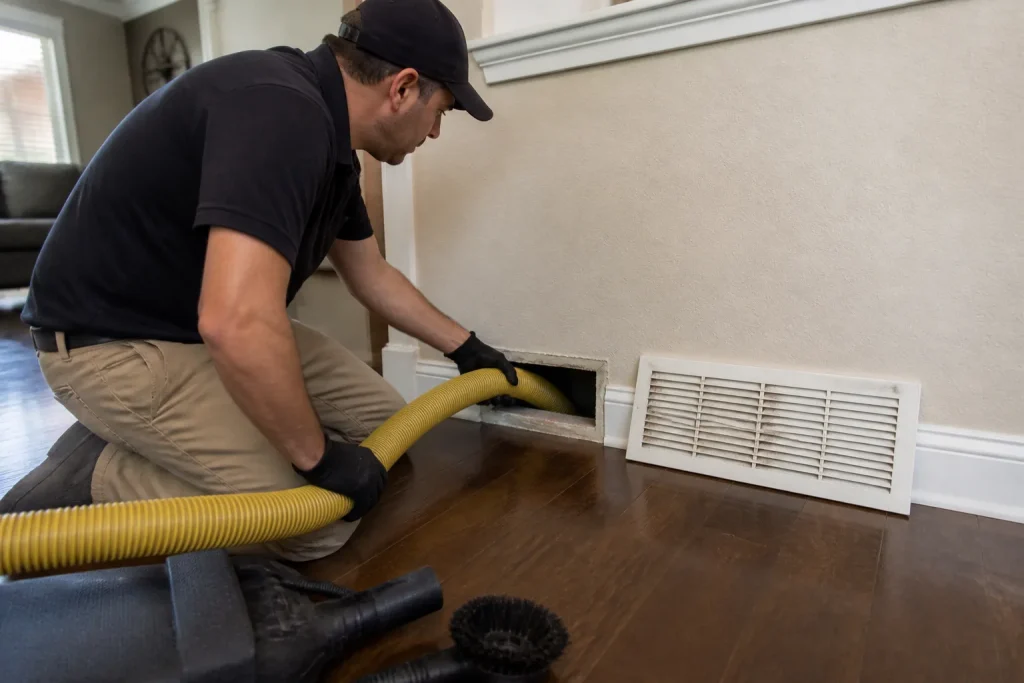
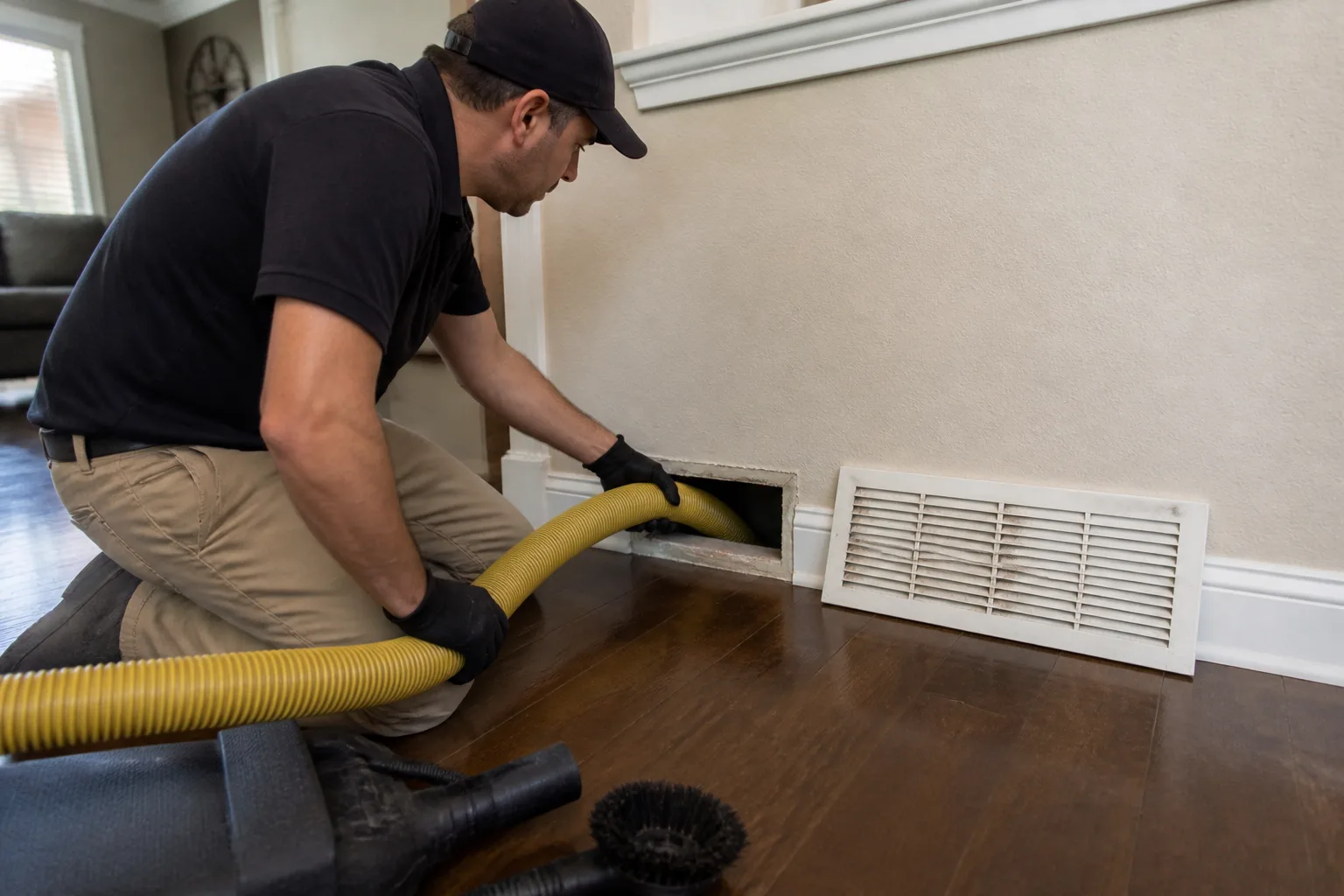
These are two different methods, and good duct cleaning usually uses both. Contact vacuuming means a hose or brush head physically touches the duct interior and lifts material. Negative pressure means the whole system is put under a controlled vacuum so that loosened material travels toward one collection point instead of escaping elsewhere.
Here’s the part most homeowners don’t hear. Contact vacuuming alone can’t control where dust goes once it’s airborne. Negative pressure alone won’t pry caked material off a duct wall. You need the brush to agitate and the airflow to capture. That’s why we pair the Rotobrush mechanical brush system with Nikro negative air equipment: one loosens, the other removes.
When we describe mechanical brush cleaning, we mean a rotating brush head that physically contacts the duct surface. Air-washing methods, where a technician only blows compressed air through the system, can dislodge material without ever scrubbing it. Sometimes that’s adequate. Often it isn’t.
A Beaumont home with original flex duct and years of settled dust is a good example. The material clings. A brush reaches it. Air alone moves the easy layer and leaves the rest.
What does HEPA filtration actually capture?
HEPA filtration on extraction equipment captures particles down to 0.3 microns at high efficiency. That range matters more than most people realize, because it covers the fine particulate that stays airborne longest and penetrates deepest into lung tissue.
Without proper filtration on the vacuum, those particles pass straight through the machine and back into the room. You’ve paid for cleaning and ended up with a fine dust event.
So when you’re evaluating a contractor, ask what filtration their extraction equipment uses. It’s a fair question and a specific one. If the answer is vague, that tells you something.
- Coarse debris: hair, lint, construction dust, settled fibers
- Fine particulate: the fraction that hangs in the air and travels through living space
- Microbial material: relevant after water intrusion or in damp duct runs
Beaumont’s climate keeps indoor humidity elevated for months at a time, and that can make fine dust and organic material cling rather than fall. Filtered extraction is what keeps that material out of the room you’re breathing in.
How is Nikro equipment configured for different duct systems?
Residential flex duct and commercial hard-pipe systems need different setups. Flex duct is corrugated, lighter-walled, and easier to damage with the wrong brush pressure or airflow. Hard-pipe systems in commercial buildings tolerate more aggressive mechanical action and higher static pressure.
That distinction matters in Beaumont because the housing stock is mixed. Older homes, newer builds, and light commercial spaces all sit within the same few miles. A setup tuned for one won’t necessarily suit another.
What a proper configuration involves:
- Matching airflow to duct type. Too much negative pressure on light flex duct can collapse a run or pull a connection apart.
- Choosing the right brush head. Softer tooling for flexible duct, firmer for rigid metal.
- Sealing every other register. Negative pressure only works if the system is closed except at the point of extraction.
- Confirming pressure before starting. A technician should verify the vacuum is holding before the brush goes in.
We also work with Honeywell and Aprilaire whole-home air quality components, which show up in a lot of Beaumont systems. Knowing how those components interact with cleaning equipment keeps the work from damaging filtration and humidification gear in the process. If you want the fuller picture of how cleaning fits into home air quality, our air duct cleaning page covers the basics.
What should you see and hear during a Nikro-based cleaning?
You should see registers sealed and hear steady machine noise. That’s the short version. Here’s what a properly run job looks like from the homeowner’s side of the room.
- Register sealing: Every supply and return except the extraction point should be covered. If you can feel air moving at a vent while the machine runs, the containment isn’t complete.
- Negative pressure confirmation: The technician checks that the system is pulling, not pushing. This is a quick verification, but it’s the one that separates a real job from theater.
- Debris collection verification: At the end, you should be able to see what came out. Ask to look. A contractor with nothing to show has a problem.
- Before-and-after photos: We take them of your own ducts, not stock images. Photos of a different house tell you nothing.
One light note: if the machine sounds like a jet idling in your hallway, that’s roughly right. It’s supposed to be loud. Quiet equipment is usually underpowered equipment.
Abatement Technologies negative-air and containment gear rounds out the setup on jobs where capturing contaminants at the source matters most. That’s remediation-grade technology, and it’s built for exactly this kind of work.
When does equipment choice matter most?
Some jobs are routine. Others aren’t, and those are the ones where the machine class makes a visible difference.
Post-renovation cleanups. Drywall dust, sawdust, and insulation fibers get pulled into return ducts during construction. That material is fine and travels easily. Filtered negative pressure is what keeps it from settling across the whole house after the crew leaves.
Mold remediation support. When a duct system has been affected by moisture, cleaning has to capture microbial material rather than aerosolize it. That’s containment work, and it needs equipment designed for it.
Homes with immunocompromised occupants. When someone in the house has a compromised respiratory system, the margin for error shrinks. Fine particulate that would be a minor nuisance for most people becomes a real concern. This is the situation where we’d encourage homeowners to ask detailed questions about filtration, airflow, and containment before booking anyone.
In each of these cases, the question isn’t whether the ducts get brushed. It’s whether what comes off the walls gets captured. That’s the equipment’s job.
When to call a pro
If you’re seeing visible dust blowing from registers, noticing musty odors when the system runs, or you’ve just finished a renovation, it’s worth having someone look at the system rather than guessing. Duct repair is often part of the answer too, since disconnected or leaking runs undo the cleaning almost immediately. We clean it, and we can fix it, which saves you a second call. For lint buildup around the laundry area, dryer vent cleaning addresses a separate but related fire risk.
Related services in Beaumont: air duct cleaning, air duct repair, and dryer vent cleaning, all handled by one company. You can read more about the area we cover on our Beaumont page.
How do you evaluate a contractor’s equipment before hiring?
Ask direct questions and listen for specific answers. Vague reassurances are the tell.
- What negative air equipment do you use, and what’s its CFM rating?
- Does your extraction equipment use HEPA filtration?
- Do you use mechanical brush cleaning or air-only methods?
- Will you show me before-and-after photos of my own ducts?
- Is the price per system or per vent?
That last one matters. Per-vent pricing creates an incentive to rush. A flat price per system, agreed before work starts, means the technician isn’t watching a clock. It’s also the honest answer to the bait-and-switch reputation this trade has earned. A low teaser number that balloons once the equipment is in the driveway is a story homeowners tell us about constantly.
Our technicians have up to 14 years of experience, and the questions above are the same ones we’d want answered if we were hiring someone for our own homes.
The Bottom Line
Nikro equipment matters because duct cleaning is a containment problem before it’s a scrubbing problem. Suction volume, airflow direction, and HEPA filtration determine whether loosened debris leaves your home or redistributes inside it. Mechanical brush cleaning loosens what’s stuck. Negative pressure captures it. Filtration keeps the fine fraction out of your air.
If you’re in Beaumont and need help, Beaumont Duct Cleaning offers free estimates. Call (866) 935-2761. We answer 24/7, with fast dispatch from 7am to 7pm, Sunday through Friday. You’ll get one flat price per system agreed before work starts, plus before-and-after photos of your own ducts. For a full view of what we do, start with Beaumont Duct Cleaning.
Frequently Asked Questions
It depends on the size and layout of your system, so we price per job by written estimate rather than quoting a number sight unseen. The estimate is free, and the written figure sets the final price. Call (866) 935-2761 for an exact quote.
Usually because the equipment is smaller and the process is faster. A shop vac and an air hose cost less to run than a negative air machine with HEPA filtration. You’re not comparing the same job. Ask what CFM the equipment produces and whether the extraction is filtered before you compare prices. Call (866) 935-2761 if you’d like to talk through the difference.
Ask for before-and-after photos of your own ducts and look at what came out of the system. Register sealing and negative pressure confirmation during the job are the other two checkpoints. A contractor who can’t show you any of that hasn’t given you proof. Call (866) 935-2761 to book a job where you get all three.
Most homes don’t need it on a fixed schedule. Visible dust blowing from registers, musty odors when the system runs, recent renovation work, or a home inspection finding are the usual triggers. If any of those apply, call (866) 935-2761 for a free estimate.
Written by the team at Beaumont Duct Cleaning.
Need Air Duct Cleaning Help?
Call Beaumont Duct Cleaning - licensed & insured, here with fast help in Beaumont.
(866) 935-2761